 Skip to content

Request a Healthcare Security Assessment!
Companies Who Trust Triumph





Healthcare Security Services
Healthcare is the only industry where the security officer is surrounded by people who cannot leave, cannot be turned away, and are frequently having the worst day of their lives. Emergency departments receive patients regardless of behavior. Behavioral health units hold people in crisis. Visitors arrive frightened, exhausted and sometimes intoxicated. Nurses absorb more workplace violence than almost any other occupation, and most of it never gets reported because it has been normalized as part of the job.
The regulatory environment reflects that. California hospitals have operated under a healthcare-specific workplace violence prevention requirement since well before the general employer rule arrived: Health and Safety Code section 1257.7 obliges hospitals to adopt a workplace violence prevention plan, to train personnel, and to report violent incidents to Cal/OSHA. Separately, the HIPAA Security Rule’s physical safeguards at 45 CFR 164.310 make facility access control a compliance function rather than a convenience, and EMTALA constrains what anyone, including security, may do that could look like turning a patient away.
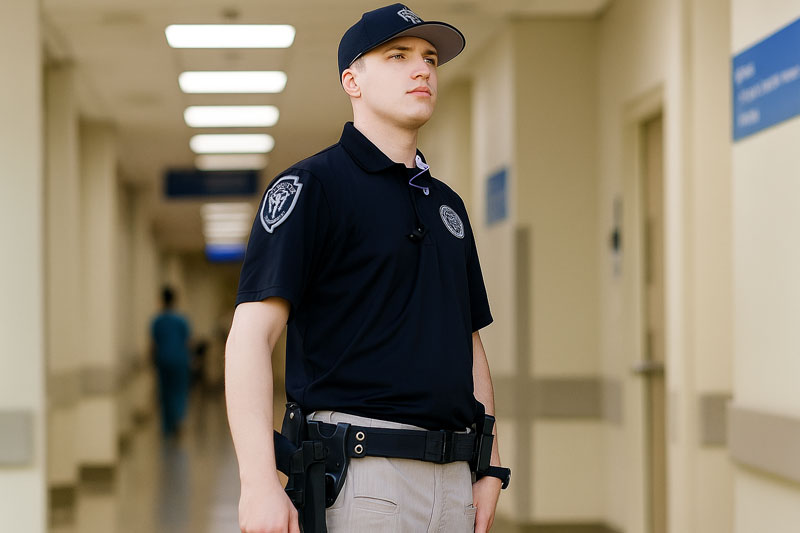
Triumph Protection Group staffs hospitals, emergency departments, behavioral health units, clinics, surgery centers and medical office buildings. Our healthcare officers are trained to work inside a clinical hierarchy, to de-escalate rather than to control, to keep their hands off patients absent a genuine emergency, and to understand that in this environment the clinician is in charge and security supports.
The Emergency Department Is The Highest-Risk Room In The Building
Every characteristic that makes a location dangerous converges in an emergency department. It is open continuously, it cannot decline entry, it holds people in pain and in withdrawal, it produces long waits that feel unjust to the person waiting, and it mixes patients, families, law enforcement custody transfers and psychiatric holds in one space. The violence rate there is not a failure of the department. It is a structural property of the department.
A healthcare officer in an emergency department is a fixed post, not a rover. The value is being present when a triage conversation turns, standing where the nurse can see them, intervening verbally early rather than physically late, and taking the escalating family member out of the room before the confrontation forms. The single most useful thing an ED officer does is reduce the number of situations that ever require force.
It also means understanding what an officer may not do. EMTALA obligations mean nobody, including security, does anything that functions as turning a patient away or discouraging them from seeking care. Removing a disruptive visitor is a different act from removing a patient, and our post orders draw that line explicitly with the charge nurse holding the decision.
The Hospital Workplace Violence Prevention Plan
California hospitals carry a sector-specific obligation under Health and Safety Code section 1257.7: adopt and implement a workplace violence prevention plan, assess environmental and patient-specific risk factors, train personnel on recognizing and responding to violence, and report violent incidents to Cal/OSHA within defined timeframes. Unlike a general workplace plan, this one contemplates the reality that the person who becomes violent is often the patient you are treating.
Our role is to make the plan operational at the point where incidents actually occur. Officers are briefed on your specific plan rather than a generic curriculum, they know which incidents trigger a reporting obligation, and they write reports that give your safety officer the fields the report requires rather than a narrative that has to be reinterpreted.
The chronic problem in healthcare is under-reporting. Verbal threats, grabbing, spitting and being struck are widely absorbed by clinical staff as routine. We instruct officers to document every one they witness or that is reported to them, precisely because the statutory scheme depends on the incident record existing, and because a hospital that reports few violent incidents while its staff experience many has a data problem rather than a safety success.
HIPAA, Physical Safeguards And What Security Actually Touches
Security in healthcare is inside the compliance perimeter, not adjacent to it. The HIPAA Security Rule’s physical safeguards standard at 45 CFR 164.310 addresses facility access controls, workstation security and device and media controls, and every one of those has an officer component.
Facility Access Controls
Controlling who enters areas where protected health information is stored or accessible is a security function performed against a compliance standard. That means badge and escort enforcement at medical records, health information management, data center and server areas, verification of vendor and contractor access to those spaces, and after-hours entry control at doors that are convenient rather than monitored. An access exception that nobody reviews is a finding waiting to happen.
What Officers Do Not See
Our officers are trained that protected health information is not theirs to look at, discuss or record. They do not read charts or screens, do not repeat what they overhear, and do not include diagnosis, treatment or clinical detail in incident reports. A report describes behavior, location, time and response. It does not describe a condition. Where an officer must reference a patient, the reference is by room or by identifier per your policy rather than by clinical circumstance.
Devices, Media And The Quiet Loss
Unattended workstations, laptops in unlocked offices, portable media and paper left at a printer are ordinary findings on a night round and are exactly the conditions that produce a reportable breach. Officers note and report them through the same channel as any other finding, which turns a nightly patrol into a recurring physical-safeguard audit at no additional cost.
Behavioral Health And The Clinical Boundary
Behavioral health is where healthcare security most often goes wrong, and the failure mode is almost always an officer stepping over a clinical line with good intentions. Restraint of a patient is a clinical intervention with orders, documentation, monitoring and regulatory consequences. It is not a security decision, and our officers do not initiate it.
What officers do is support: maintain presence so clinical staff can work, control the environment by removing objects and clearing space, manage doors and other patients, assist physically only at the direction of clinical staff and within the technique your facility trains, and document what happened without characterizing the patient. The distinction between assisting a clinically directed intervention and performing a security restraint is not semantic, and we train to it deliberately.
Verbal de-escalation carries the majority of the load. Distance, tone, unhurried speech, removing an audience, offering a real choice and giving the person a way to comply without humiliation resolve most encounters. Officers are told plainly that a de-escalated encounter that took twenty minutes is a better outcome than a controlled one that took ninety seconds.
Infant Security, Elopement And Patients Who Wander
Infant and pediatric abduction response is drilled, not filed. Officers assigned to facilities with maternity or pediatric units know the alert designation your facility uses, the exit and stairwell positions they cover on activation, the physical description discipline required, and the rule that all exterior doors are held rather than searched first. A response plan that has never been walked is a document, not a capability.
Elopement of an at-risk patient runs a parallel structure: immediate notification, exit coverage, a defined search sequence starting with the most likely egress and the parking areas, and coordination with nursing so that the search is bounded and documented rather than diffuse. Officers cover doors and grounds while clinical staff manage the unit.
Wandering and confusion cases, particularly with elderly patients, are handled gently and constantly. The officer who walks a confused patient back to a unit calmly, several times a night, is doing security work even though nothing on the report looks like an incident.
Access Control, After-Hours Entrances And Controlled Areas
Hospitals are functionally open buildings with hardened pockets, and the security problem is the geography between them. We cover the entrances that are actually used at three in the morning rather than the ones on the map, verify vendor and contractor access to pharmacy, supply, laboratory and equipment areas, and check that controlled-substance storage doors are secured on every round.
Visitor management outside of published hours is enforced consistently, including for people who are plainly upset and plainly sympathetic, because inconsistent enforcement is what creates both the security gap and the complaint. Officers are trained to give a clear reason and a real alternative rather than a flat refusal.
Parking structures and the walk between them and the building carry their own risk, particularly at shift change, and staff escorts are offered as routine practice rather than on request. Overnight clinical staff walking alone to a distant structure is the most common unaddressed exposure we find on a first survey.
Reporting That Serves Compliance, Not Just Security
Every shift produces a written report of rounds completed, access exceptions, physical-safeguard findings and incidents, delivered to the contacts you name including your safety officer and, where you designate, your privacy or compliance lead.
Incident reports are written the same shift by the observing officer, describe behavior and response rather than condition, include times accurately, and reference camera windows where they exist. They are drafted so that your workplace violence reporting obligation can be satisfied from them directly rather than through a second round of interviews days later.
Monthly reporting aggregates by unit, hour and category. In healthcare that aggregation is usually what wins resources: a specific unit at a specific hour producing a specific type of incident is a case for staffing or a physical change, while a general sense that the emergency department is difficult is not.
Healthcare Coverage Models Compared
Healthcare organizations choose among officers trained specifically for clinical environments, general contract guards assigned to a hospital, and relying on clinical staff plus a code response. The differences appear in behavioral health encounters, in privacy findings and in what the incident record can support.
| Clinical Environment Need | Trained Healthcare Officer | General Contract Guard | Staff-Only Code Response |
|---|---|---|---|
| Emergency department presence | Fixed post, de-escalates early | Present but often roving | None until a code is called |
| Clinical boundary on restraint | Assists only at clinical direction | Frequent source of error | Clinically correct by definition |
| Workplace violence reporting | Documents every witnessed incident | Inconsistent; often unreported | Chronically under-reported |
| HIPAA physical safeguards | Access exceptions and device findings logged | Not part of the brief | Not systematically checked |
| Infant abduction response | Drilled positions, doors held | Plan read, rarely walked | Depends on staffing at that hour |
| Elopement and wandering | Exit coverage and bounded search | Ad hoc | Pulls clinical staff off the unit |
| Evidence quality for a claim | Same-shift reports, no clinical detail | Variable quality | Chart entries only |
Healthcare Security: Frequently Asked Questions
Will your officers restrain a violent patient?
Not on their own initiative. Restraint of a patient is a clinical intervention requiring orders, documentation and monitoring, and it is not a security decision. Our officers maintain presence so clinical staff can work, clear the space, remove hazards, manage doors and other patients, and assist physically only at the direction of clinical staff and within the technique your facility trains. That boundary is written into the post orders because crossing it is the most common and most costly error in healthcare security.
How do you keep officers compliant with HIPAA?
By treating protected health information as something officers never handle. They do not read charts or screens, do not repeat what they overhear, and do not put diagnosis, treatment or clinical detail into incident reports, which describe behavior, location, time and response instead. On the physical side, officers actively support the safeguards at 45 CFR 164.310: badge and escort enforcement at records and data areas, vendor access verification, after-hours door control, and reporting unattended workstations, unsecured devices and paper left at printers.
Do you cover emergency departments overnight?
Yes, and for most hospitals it is the first post we would recommend funding. The emergency department is open continuously, cannot decline entry, holds people in pain and withdrawal, produces long waits and mixes patients, families, custody transfers and psychiatric holds in one space. A fixed post there prevents far more incidents than a roving officer who arrives after a situation has already formed.
What is your role under our workplace violence prevention plan?
Operational rather than administrative. California hospitals must adopt a plan, train personnel and report violent incidents to Cal/OSHA under Health and Safety Code section 1257.7, and the duty stays with the hospital. What we do is brief officers on your specific plan, ensure they know which incidents carry a reporting obligation, and write reports that contain the fields your safety officer needs. We also instruct officers to document every incident they witness, including the verbal threats and grabbing that clinical staff have learned to absorb.
How is an infant abduction response handled?
As a drilled capability rather than a filed plan. Officers at facilities with maternity or pediatric units know your alert designation, the specific exits and stairwells they cover on activation, the description discipline required, and the rule that exterior doors are held before any searching begins. We walk those positions with your team rather than reading them, because a response nobody has physically rehearsed will not work at three in the morning with two officers on shift.
Can officers turn away a disruptive person from the ED?
A visitor, yes, with the charge nurse involved. A patient, no. EMTALA obligations mean nothing security does may function as turning a patient away or discouraging them from seeking care, and our post orders draw that line explicitly with the clinical decision resting with the charge nurse or physician. Officers manage the behavior and the environment; they do not make access decisions about patients.
Are healthcare officers armed?
Usually unarmed, and that is the appropriate default for most clinical settings, where the population includes patients in altered mental states and the risk introduced by a weapon in a struggle is significant. Armed coverage is considered for specific circumstances such as facilities with a documented history of armed incidents, isolated locations with long law enforcement response, or specific threat situations, and it is recommended in writing after assessment rather than applied as a standard.
Do you staff clinics and medical office buildings, not just hospitals?
Yes. Outpatient clinics, surgery centers, dialysis centers, imaging centers, behavioral health clinics and medical office buildings all have security needs that differ from a hospital’s, typically centered on lobby management, after-hours access, staff escorts, pharmacy and supply areas, and de-escalation with frustrated patients. Coverage is often part-time or evening-focused, and we scope it to the hours where incidents actually occur rather than to a full-time post by default.
Healthcare Security By Location
Tell us the facility, the units involved, and which hours your staff would describe as the hard ones. We will walk the emergency department and the after-hours entrances at the hours they are actually used, and put post orders in front of your safety officer before anyone is assigned.
Licensed. Hospitals, emergency departments, behavioral health units, surgery centers, clinics and medical office buildings.