 Skip to content

Keep your property protected, your projects on track, and your costs under control with Triumph’s Watchtower mobile surveillance system.
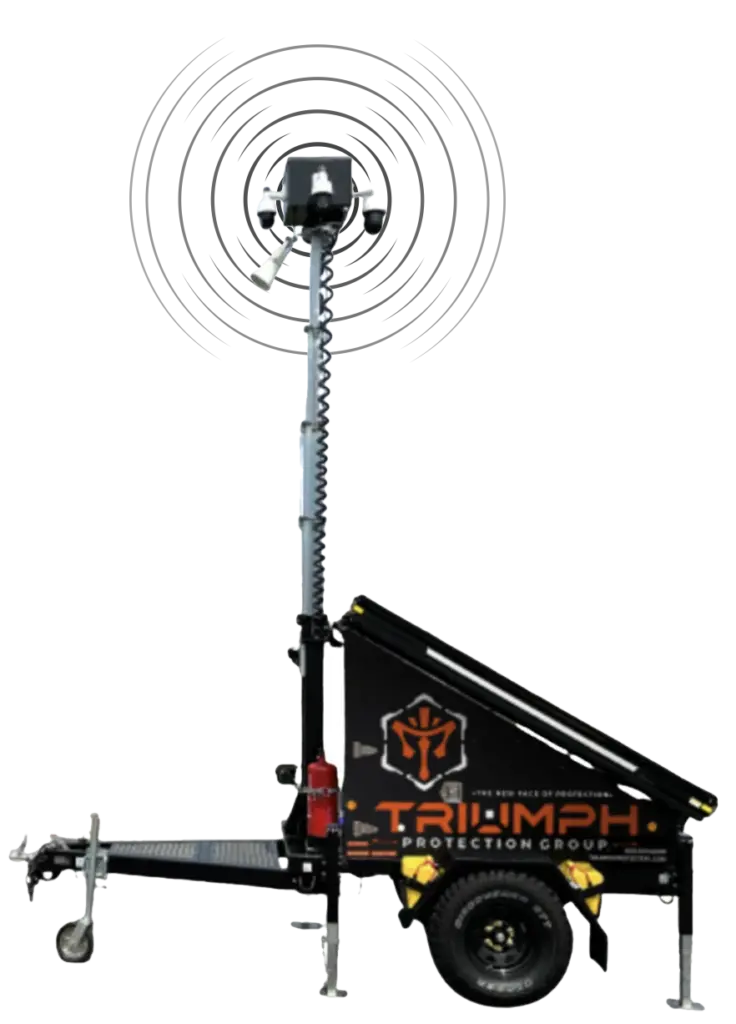
Triumph Watchtower Mobile Surveillance Units
The Triumph Watchtower is a self-contained mobile surveillance unit that puts a lit, elevated, camera-equipped tower on a site that has no power, no network and no infrastructure. It arrives on a trailer, deploys in hours, and starts producing monitored video the same day. Nothing is trenched, nothing is mounted to a building, and nothing is left behind when the job ends.
This solves a problem fixed cameras cannot. A construction site has no permanent structure to mount to and moves as the build progresses. A parking lot with a theft problem this quarter may not have one next quarter. A grand opening, a festival or an emergency response staging area exists for days. Permanent infrastructure is the wrong tool for temporary or shifting risk, and it is almost always the most expensive way to solve it.
Each unit carries its own power generation and storage, its own cellular connectivity, high-visibility lighting and a mast that raises cameras well above eye level where they cannot be casually blocked, reached or defeated. Paired with live monitoring, the tower is not just recording your site; it is a visible, illuminated statement that the site is watched, which is most of the deterrent value before a single incident occurs.
What The Triumph Watchtower Actually Is
A Watchtower unit is a trailer-mounted surveillance platform. On it sits a telescoping mast carrying a camera array, a lighting head, solar panels feeding a battery bank, a cellular communications package and a weather-sealed equipment enclosure. It is towed into position, levelled and stabilised, raised, aimed and brought online.
The point of the mast is elevation. Cameras at eye level are obstructed by vehicles, stacked material and fencing, and they are reachable by anyone with a can of spray paint. Cameras at mast height see across a whole yard, look down into vehicle rows and material stacks, and are effectively out of reach without equipment that draws attention long before it is used.
The unit is also deliberately conspicuous. It is large, lit, and unmistakably a surveillance installation. Unlike a discreet camera that a determined offender may never notice, a Watchtower announces itself from the road. A meaningful proportion of the crime it prevents is prevented by people who look at the site, see the tower, and choose a different target entirely.
Deployment, Power And Connectivity
Everything about the unit is designed around sites that have nothing. That constraint drives the engineering, and it is what makes the difference between a tower you can put anywhere and one that still needs an electrician and a network drop.
Solar Generation And Battery Storage
Onboard photovoltaic panels charge a battery bank sized to carry the unit through the night and through consecutive overcast days. There is no generator to refuel, no fuel theft risk, and no running cost per hour. For sites with genuinely poor solar exposure, such as deep urban canyons or heavily shaded lots, we can specify supplementary charging rather than pretending the geometry works.
Cellular Uplink And Bandwidth
Video reaches the monitoring centre over a cellular connection with the carrier selected for actual signal strength at your specific address, not for whichever network is nominally best in the region. Encoding is tuned so that live monitoring and clip retrieval work reliably on the bandwidth genuinely available, with local recording as a fallback so nothing is lost if the link drops.
Siting, Sightlines And Setup
Placement is a survey question. We look for a position with sightlines across the highest-value areas and the likely approach routes, stable and level ground for the stabilisers, adequate solar exposure, and visibility from the public road for deterrent effect. Where a unit will sit near a public right of way, we flag any local permit requirements before deployment rather than after a code officer visits.
Where Mobile Beats Fixed
Fixed camera systems are the right answer for a permanent site with a stable risk profile and existing infrastructure. They are the wrong answer for almost everything else, and the mismatch is expensive in both directions.
Construction is the clearest case. The high-risk area moves through the programme: the material laydown yard matters during the frame, the mechanical rooms matter during fit-out, the finished units matter at the end. Fixed cameras installed at mobilisation are watching the wrong ground within months. A Watchtower is repositioned in an afternoon and follows the value.
The same logic covers seasonal retail overflow lots, temporary storage compounds, remote utility and pipeline works, film and event production sites, and properties held vacant between tenants. It also covers the situation nobody plans for: a site that has just been hit twice and needs visible protection this week, not after a six-week installation schedule.
Detection, Talk-Down And Escalation
A tower with nobody watching it is an expensive light pole. Watchtower units are paired with live monitoring so that detections reach a person who can act. Analytics classify people and vehicles inside defined zones during defined hours, suppressing weather, wildlife and passing traffic, and escalate genuine intrusions to an operator.
Units can be specified with a speaker for live talk-down, allowing an operator to address an intruder directly and describe what they are wearing and doing. Where a talk-down does not resolve the situation, the operator dispatches law enforcement with a live description and continuing position updates, and the incident is captured as timestamped clips with a written narrative for your records and for prosecution.
Deterrent lighting and strobe can be triggered as an intermediate step. Illuminating a subject and marking them is often enough on its own, and it escalates the situation visibly to anyone else nearby without requiring a spoken challenge. The response ladder is configured per site rather than applied uniformly.
License Plate Recognition And California ALPR Rules
For sites with a defined vehicle entrance, automated license plate recognition turns the tower into an access record. Every plate entering and leaving is captured, timestamped and searchable, which is decisive after an incident: instead of asking who might have been on site, you have a list. It also supports watchlist alerting where a specific vehicle has been involved in prior incidents.
California regulates this capability specifically. Civil Code section 1798.90.5 and the sections following it govern operators of automated license plate recognition systems, requiring a publicly available usage and privacy policy, reasonable security procedures to protect the data, retention limits, and restrictions on sharing plate data. Operators must also maintain records of access to the information.
We treat those obligations as part of the deployment rather than an afterthought. Clients running plate recognition through a Watchtower receive a usage and privacy policy configured to their deployment, defined retention periods, and controlled access. A capability deployed without that framework creates a statutory exposure that easily outweighs the security benefit, and we will not configure it that way.
Lighting, Visibility And Deterrence By Design
Lighting is not decoration on these units, it is a security control in its own right. Poorly lit sites suffer more incidents, and lighting that produces deep shadow between bright pools can be worse than uniform lower-level illumination because it creates concealment directly beside the light. The Illuminating Engineering Society publishes recommended practice for parking and outdoor area lighting, and uniformity ratios matter as much as raw output.
Watchtower lighting is positioned from height, which produces broader and more even coverage than pole-mounted or ground-level fixtures and reduces the shadowed pockets that offenders use. It also lights the ground the cameras are watching, which directly improves detection and identification quality at night, when the great majority of intrusions occur.
Adequate lighting also carries a liability dimension. Where a property owner knows an area is dark and has produced incidents, and does nothing, that knowledge tends to feature in any subsequent claim. A deployed, documented lighting and surveillance response is evidence of a reasonable owner acting on known risk.
Typical Deployment Scenarios
Construction and development sites are the highest-volume use, protecting copper, tooling, fuel, appliances and plant across a footprint no single guard can cover. Units move with the programme and scale up as the value on site increases.
Retail and commercial parking is the second: shopping centre lots with vehicle break-in problems, dealership overflow inventory, and seasonal expansion areas that exist for eight weeks a year. Deployment for the exposed period only is far cheaper than installing infrastructure that then sits unused.
Beyond those, we deploy for events and film production, for municipal problem locations such as parks and transit facilities during specific enforcement periods, for utility and energy works in remote locations with no services at all, and for emergency and disaster staging areas where equipment and supplies accumulate rapidly in a place that had no security the previous week.
Triumph Watchtower: Frequently Asked Questions
How quickly can a Watchtower be deployed?
For a site within our operating footprint, typically within a few business days of agreement, and the unit is generally live within about four hours of arriving on site. That covers positioning, levelling and stabilising, raising the mast, aiming cameras, confirming the cellular link and completing the monitoring handover. Sites needing permits for placement near a public right of way should allow additional lead time, and we identify that requirement up front.
Does the unit need power or internet on site?
No. Each unit generates its own power through onboard solar panels feeding a battery bank sized to run through the night and through consecutive overcast days, and it connects over cellular rather than site network. That is the entire design premise: it works on ground where nothing has been built yet. For sites with genuinely poor solar exposure we specify supplementary charging rather than claiming it will be fine.
Can it be stolen or vandalised?
It is built to resist exactly that. The trailer is secured against towing, the equipment enclosure is locked and alarmed, and the cameras sit at mast height beyond casual reach. The unit monitors itself, so tampering triggers the same escalation as any other intrusion, with an operator on the feed within seconds. Units are also positioned where they are visible from the road, since concealed equipment attracts more interference than conspicuous equipment.
How far can the cameras actually see?
It depends on the camera specification and what you need to achieve. Detecting that a person is present is possible at considerably greater distance than identifying who they are. We survey the site and specify the array against your actual objective, and we will tell you plainly if the coverage you want needs two units rather than one instead of overselling a single tower.
Is license plate recognition included?
It is an option rather than a default, and it is worth having wherever there is a defined vehicle entrance. If you take it, California law applies: Civil Code section 1798.90.5 and the sections following require plate recognition operators to publish a usage and privacy policy, apply reasonable security to the data, observe retention limits and restrict sharing. We configure that framework as part of the deployment, because running the capability without it creates more exposure than it removes.
Can I rent one for just a few weeks?
Yes. Short-term, seasonal and long-term terms are all available, and short deployments are a large part of what these units are for. Common examples are an eight-week seasonal overflow lot, a festival or production period, or a defined response to a cluster of incidents. There is no capital outlay and nothing is left installed on your property afterwards.
Does a Watchtower replace a security guard?
For deterrence and detection across open ground, it does a great deal of what an overnight guard does, and it does it across the whole site simultaneously rather than one location at a time. It cannot control access, check credentials, escort anyone, respond to a medical emergency or physically intervene. Sites needing those functions need people, and many clients run a tower overnight with staffing during working hours.
What happens when the site moves or the project ends?
We reposition it. Relocation within a site is usually an afternoon, and moving between sites is a scheduled tow. When the project finishes the unit leaves and there is nothing to decommission, no fixings to make good and no redundant cabling in your walls. That is the central advantage over a fixed installation on a site with a defined end date.
Watchtower Deployment By Location
Send us the site address, how long you need coverage and what is on the ground worth protecting. We will survey the location, tell you how many units it genuinely needs, and quote the deployment as a fixed rental rather than an open-ended estimate.
Licensed. Mobile surveillance deployment, monitored video and guard services available.