 Skip to content

Keep Your of Hospitality Business Secure!
Hospitality Security Services
A hotel sells the feeling of being looked after. Security that reads as suspicion sells the opposite, and guests notice within seconds of walking through the door. That is the constraint every hospitality security program works inside: the officer has to be unmistakably present at two in the morning when a guest is walking to a far parking space, and effectively invisible at seven in the evening when the lobby is full of people checking in.
Underneath that service question sits a set of legal obligations that are specific to lodging and that most operators underestimate. Innkeepers carry a heightened common-law duty of care toward guests. California requires hotel and motel employers to provide human trafficking awareness training to employees likely to interact with victims under Government Code section 12950.3, and a hotel liability statute effective January 1, 2023 exposed operators to civil liability where supervisory employees knew of or acted in reckless disregard of trafficking activity and failed to act. Separately, an occupancy that runs past thirty consecutive days can convert a transient guest into a tenant with eviction protections, which turns a routine lockout into an unlawful one.
Triumph Protection Group staffs hotels, resorts, extended-stay properties, restaurants, bars and banquet operations. Our officers are briefed on the guest-versus-tenant line, on trafficking indicators, and on the fact that in hospitality the correct answer to almost every situation is the quietest one that works.
Service Presence, Not Police Presence
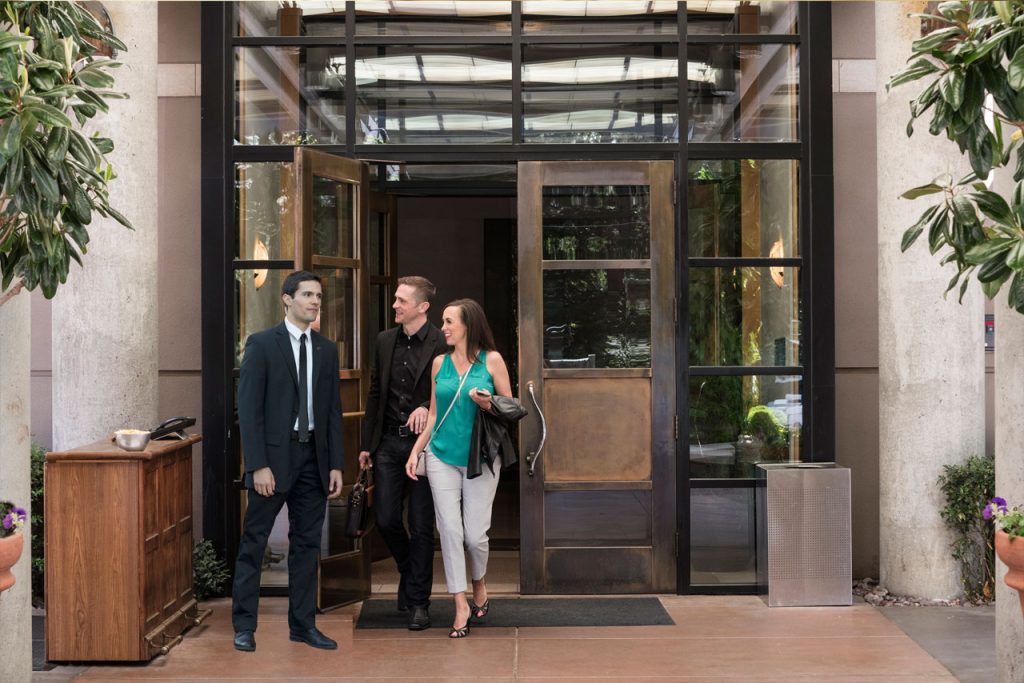
The single most common complaint about hotel security is not that it failed. It is that it felt wrong. An officer who stands with folded arms scanning the lobby communicates that something is expected to happen here. An officer who greets, gives directions, walks a guest to their car and is visibly available communicates the opposite while doing exactly the same job.
We brief hospitality officers on presentation as a working requirement rather than a courtesy. Posture, greeting, tone, uniform choice and where the officer physically stands are all part of the post orders, and they vary by property. A resort, an airport property and a downtown extended-stay each read a security presence differently, and the same officer behavior lands differently in each.
This does not soften the security function. It makes it usable. Guests report concerns to an officer who has spoken to them pleasantly and rarely to one who has not, and staff escalate earlier to someone they are comfortable approaching. Most of what a hotel officer learns arrives through those conversations rather than through observation.
Guest Or Tenant: The Line That Turns A Lockout Into A Claim
This is the legal trap most specific to lodging, and it catches good operators. A transient hotel guest can generally be removed for non-payment or misconduct through the property’s own procedures. An occupant who has stayed past roughly thirty consecutive days may have acquired tenancy rights, and removing a tenant requires a formal legal process rather than a key deactivation and an escort.
Extended-stay and long-occupancy properties live in this territory constantly, and so do full-service hotels with a handful of guests who quietly never leave. Our officers are instructed never to assist with a lockout or a room entry for removal without confirming with management that the occupancy status has been checked, and to escalate rather than proceed where the answer is unclear. We are not your counsel and we do not make that determination, but we will not participate in a removal that nobody has verified.
What Officers Do Instead
Where the status is uncertain, the officer keeps the peace, documents behavior and conditions precisely, and supports whatever lawful process management and counsel elect to pursue. Documentation of the actual conduct, dated and specific, is what makes a later legal process straightforward. An escalating series of undocumented verbal warnings is what makes it fail.
Room Entry And Guest Privacy
Entry into an occupied guest room is a management decision governed by property policy and law, not a security decision. Our officers accompany authorized staff, never enter alone, document the reason, time, persons present and observations, and treat guest belongings as untouchable absent a specific lawful basis directed by management. Where a welfare check or emergency is involved, the response is immediate and the documentation follows within the shift.
Trafficking Awareness And The Duty It Creates
Lodging is where trafficking becomes visible, which is why California and a growing number of states impose training obligations on hotel operators. Government Code section 12950.3 requires hotel and motel employers to provide at least twenty minutes of human trafficking awareness training to employees likely to interact with victims, and the state’s 2023 hotel liability statute created civil exposure where supervisory employees knew of or recklessly disregarded trafficking activity on the property and failed to act.
Our officers are briefed on the indicator set that actually shows up at the front desk and in the corridors: cash payment for extended stays with refusal of housekeeping, a third party controlling identification and speaking for others, frequent short-duration visitors to one room, guests who appear coached or unable to state where they are, minors with unrelated adults, and unusual requests for privacy at check-in. Indicators are not proof, and officers are trained to report them through the property’s defined channel rather than to confront or investigate.
The reporting path matters more than the observation. We agree in advance with the general manager who receives an indicator report, at what threshold law enforcement or the national hotline is contacted, and how the report is preserved. A property that has trained staff and no defined escalation still has the exposure the statute contemplates.
Overnight: The Lobby, The Corridors And The Parking Lot
Hospitality risk concentrates between eleven at night and five in the morning, when the front desk is a single employee, the lobby doors may be on card access, and the parking area is dark and largely empty. That is the shift a hotel security program exists for, and it is also the shift most commonly bought last.
Overnight posts run a defined rotation rather than a chair: interior corridor walks on every floor at varied intervals, stairwell and emergency exit checks, pool and fitness area verification after closing, parking lot and structure coverage with attention to vehicles occupied for extended periods, and a return to the lobby at intervals so the desk agent is never alone for a predictable stretch.
Escorts are offered rather than requested. Guests arriving late, staff leaving after close, and anyone walking to a distant space are offered an escort as routine practice. The offer is the deterrent as much as the walk is, and it converts an amenity into a documented safety practice.
Bar, Banquet, Pool And The Amenity Perimeter
Alcohol service creates the same exposure in a hotel bar as it does at any licensed venue, with the additional complication that the intoxicated guest is often staying upstairs. Officers back up refusal-of-service decisions, help move a guest to their room rather than to a parking lot, and coordinate with management on whether transport or a welfare check is warranted.
Banquet and event space brings outside attendance into a property whose other guests did not choose it. We staff those functions as events in their own right, with a controlled entry, a boundary between the function and the guest areas, and a plan for the moment the function ends and a hundred people move through the lobby at once.
Amenity areas fail quietly. Pools used after posted hours, fitness rooms propped open, business centers accessible to non-guests, and side doors held by a rock or a towel are the ordinary conditions that appear in every negligence claim. Officers check and correct them on every rotation and document repeat failures so the property can fix the cause rather than the symptom.
Reporting To The General Manager, Not To A File
Every shift produces a written report delivered to the general manager and any other contacts you name, covering rotations completed, incidents, guest interactions of note, amenity and access failures found and corrected, and anything escalated.
Incidents are documented in the officer’s own words the same shift, with facts separated from conclusions, times recorded accurately, and camera time references included. In hospitality, a guest injury or altercation frequently surfaces as a claim months later, when the only remaining evidence is what was written that night.
Monthly we summarize by category and location so patterns become visible: the same floor generating noise complaints, the same door found propped, the same hours producing incidents. Those patterns are usually fixable with a change in staffing or hardware, and they are invisible without the aggregation.
Hospitality Coverage Compared
Lodging operators generally choose among a dedicated on-property officer, periodic mobile patrol drive-throughs, and relying on the front desk agent to handle whatever happens. The gap shows up overnight, and it shows up in claims rather than in guest surveys.
| Property Priority | Dedicated Hotel Officer | Mobile Patrol Drive-Throughs | Front Desk Staff Alone |
|---|---|---|---|
| Overnight corridor and floor coverage | Varied rotations on every floor | Exterior only, at intervals | None; desk cannot leave |
| Guest and staff escorts | Offered as routine practice | Not available | Occasionally, leaving the desk unstaffed |
| Trafficking indicator reporting | Briefed officer with a defined channel | Minimal contact with guests | Depends on training and workload |
| Guest-versus-tenant awareness | Escalates before any lockout assistance | Not involved | Frequent source of error |
| Bar and banquet support | Backs refusal of service, manages exits | Not provided | Falls to service staff |
| Amenity and door checks | Every rotation, documented | Visual, from outside | Ad hoc |
| Evidence quality months later | Same-shift written reports | Patrol log entries only | Recollection and camera footage |
Hospitality Security: Frequently Asked Questions
Will a security officer make our hotel feel unwelcoming?
Only if the officer is deployed as a fixture rather than as staff. We treat presentation as a working requirement written into the post orders: greeting, posture, tone, uniform choice and standing position, all set per property. A resort, an airport hotel and a downtown extended-stay each read a security presence differently. Done correctly the officer reads as part of the service team, which is also why guests report concerns to a well-briefed officer and almost never to a silent one.
Can your officers help us remove a guest who will not leave?
We keep the peace, document conduct precisely and support a lawful process, but we will not assist with a lockout or removal that has not been verified by management. The reason is the guest-versus-tenant line: an occupancy running past roughly thirty consecutive days can create tenancy rights, and removing a tenant requires a formal legal process rather than key deactivation and an escort. We are not your counsel and do not make that determination, but our officers are instructed to escalate rather than proceed when the status is unclear.
How do you handle possible human trafficking on the property?
Officers are briefed on indicators that actually appear in lodging, including extended cash stays with refused housekeeping, a third party holding identification and speaking for others, frequent short-duration visitors to one room, guests unable to say where they are, and minors accompanied by unrelated adults. Officers report through a channel agreed in advance with your general manager rather than confronting or investigating. California requires hotel and motel employers to train employees likely to interact with victims, and the state’s 2023 hotel liability statute created exposure where supervisory staff disregarded activity on the property, so the escalation path matters as much as the observation.
Do officers enter guest rooms?
Not on their own initiative and never alone. Entry into an occupied guest room is a management decision governed by your policy and by law. Our officers accompany authorized staff, document the reason, the time, who was present and what was observed, and do not handle guest belongings absent a specific lawful basis directed by management. Welfare checks and genuine emergencies are responded to immediately, with the documentation completed within the shift.
What hours should we staff?
If you staff only one shift, staff the overnight. Between roughly eleven at night and five in the morning the desk is usually a single employee, the parking area is dark, and response times from every direction are longest. That window produces the disproportionate share of incidents and nearly all of the serious ones. Properties with active bars, banquet business or a large parking structure usually add evening coverage next rather than daytime.
Can you cover a banquet or wedding in addition to the property?
Yes, and we scope it as an event rather than as extra hotel hours. Function space brings outside attendance into a property whose other guests did not choose it, so we plan a controlled entry, a boundary between the function and guest areas, and coverage for the moment the function ends and everyone moves through the lobby at once. Alcohol service, ejection procedure and load-out are handled as they would be for any event.
Are hospitality officers armed?
Almost always unarmed, and that is the right default for lodging. An armed presence changes how a lobby reads to guests, and the incident profile in most hospitality settings does not support it. Armed coverage is considered for specific circumstances such as a documented threat, significant cash handling, a property in an area with an established history of armed incidents, or a protected principal in residence, and we put that recommendation in writing rather than applying it broadly.
What documentation do we receive?
A written shift report to the general manager covering rotations completed, incidents, notable guest interactions, and amenity or access failures found and corrected. Incidents are written the same shift by the officer who observed them, with facts separated from conclusions and camera time references included, because hospitality claims routinely surface months after the event when the night’s report is the only surviving evidence. Monthly summaries group incidents by category, location and hour so recurring problems become visible and fixable.
Hospitality Security By Location
Tell us the property type, the room count, whether you run a bar or banquet business, and what your overnight staffing looks like today. We will walk the property after dark rather than at noon, because that is when the gaps are visible.
Licensed. Hotels, resorts, extended-stay properties, restaurants and banquet operations, with overnight and graveyard coverage as standard.