 Skip to content

Keep Your Retail Business Secure!
Retail Security Services
Retail is the only environment where the security officer stands between a business and the people it is trying to attract. Every decision an officer makes in a store is simultaneously a security decision and a customer-experience decision, and getting the second one wrong is expensive in ways that never appear in a shrink report. A store that feels policed loses regulars. A store that feels unprotected loses inventory, then staff, then hours.
The pressure on that balance has increased. Organized retail crime has shifted from opportunistic shoplifting to coordinated groups working multiple locations, and states have responded with dedicated statutes. California created a specific organized retail theft offense under Penal Code section 490.4, aimed at people acting in concert to steal merchandise for resale, and law enforcement agencies now run regional task forces around exactly that pattern. Your officer needs to recognize it, document it in a way that supports a case, and not confuse it with a single desperate shopper.
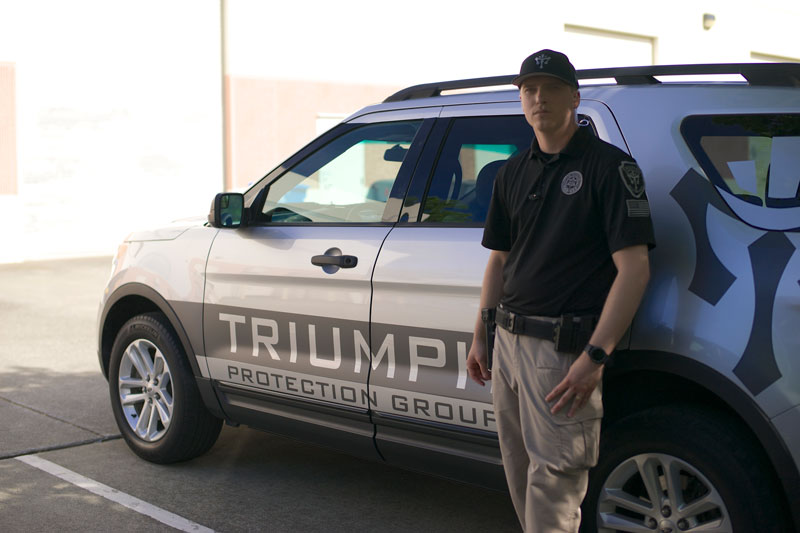
Triumph Protection Group staffs retail security in uniform where deterrence is the priority and in plain clothes where detection is. Our officers are trained specifically on the merchant detention standard, on de-escalation with the public, and on writing the kind of report a district attorney can actually use rather than a paragraph that says a subject was uncooperative.
Organized Retail Crime And Why It Broke The Old Model
The traditional retail security model assumed a lone shoplifter deterred by visibility and detained on the way out. That model still handles a share of your losses, and it does almost nothing about a crew of four that enters together, splits, fills bags on a coordinated signal, and leaves through two exits into a waiting vehicle. That event lasts ninety seconds, is often rehearsed, and is frequently the same crew that hit two of your other stores this month.
Handling it requires a different posture. Officers watch for the entry pattern rather than the theft itself: groups arriving together and separating, empty bags carried in, someone lingering near an exit without shopping, a vehicle parked facing out near a fire lane. They record vehicle descriptions and plates from a safe position, note the time and the entry point, and preserve the footage window before it rolls over. The purpose is not to make a heroic stop. It is to make the third visit prosecutable.
We also brief officers that pursuit is the wrong instinct here. Chasing a crew into a parking lot creates a vehicular and physical risk that dwarfs the merchandise value and converts your loss into a liability. The value of the officer in that ninety seconds is observation quality, not interception.
The Merchant Detention Standard Officers Work Inside
Every retail detention happens inside a narrow legal frame. California Penal Code section 490.5 gives a merchant, and an agent acting for the merchant, the ability to detain a person for a reasonable time to investigate when there is probable cause to believe that person has unlawfully taken merchandise. That authority is conditional, and each condition is a place where a program can fail.
What The Standard Requires In Practice
Probable cause is built from continuous observation, not suspicion: the officer sees the selection, sees the concealment, maintains unbroken observation through the point of sale, and observes the subject pass the last point of purchase without paying. Break the observation chain at any link and the detention is no longer defensible. Our officers are trained to abort rather than to proceed on a partial chain, and we treat an aborted stop as a correct decision, never as a failure.
Time, Manner And Force
Detention must be for a reasonable time and conducted in a reasonable manner. That means enough time to investigate and to await law enforcement, not indefinite holding, and it means force limited to what is reasonable for the circumstances. Our post orders name who may be detained, who may not, when a detention must be released, and the categories of person, such as juveniles and individuals in apparent medical or mental-health crisis, that require a different response entirely.
Why Documentation Is The Real Control
A detention that was lawful and a detention that can be proven lawful are different things eighteen months later in a courtroom. The officer records the observation chain step by step with times, the specific items and their retail value, the exact words used, who else was present, and when law enforcement was called and arrived. That contemporaneous record is what protects the store, and it is also what makes the case worth filing.
Deterrence At The Door Versus Detection In The Aisles
These are two different jobs and they are frequently confused in a single request for a guard. A uniformed officer at the entrance shifts behavior before anything happens: casual theft drops, staff feel supported, and difficult customer situations get handled by someone other than a nineteen-year-old cashier. What a uniformed officer cannot do is observe a concealment discreetly, because everyone in the store knows exactly where they are.
A plain-clothes officer does the opposite. They observe without changing behavior, build the continuous observation a lawful detention requires, and identify repeat subjects and organized patterns. What they do not do is deter, because deterrence requires visibility. Stores with a genuine shrink problem and a genuine atmosphere problem generally need both, deployed to different hours rather than to the same shift.
Where we can only staff one, we ask what the store is actually solving for: if the complaint is that customers and staff feel unsafe, the answer is a uniform at the door; if the complaint is that inventory is disappearing without confrontation, the answer is plain clothes in the aisles. Buying the wrong one and judging it on the other metric is the most common disappointment in retail security.
Opening, Closing And The Cash Path
Robbery risk in retail concentrates at open and close, and so does staff anxiety. An officer present at opening walks the interior before staff enter, verifies that the store was not occupied overnight, checks receiving doors and roof access points, and stays through the first transactions. At closing the sequence reverses: sweep the fitting rooms, restrooms and stockroom before the doors lock, hold the exit while staff leave together, and escort to vehicles.
Cash movement is handled as a defined procedure rather than as an errand. Bank runs vary in time and route, the officer never carries the deposit, the person carrying it does not park in an isolated spot, and nobody announces the run on the floor. Consistency in cash timing is the single most commonly observed weakness when we survey a new retail client.
Receiving is the other pressure point. A propped receiving door during a delivery is an open door to the stockroom, and stockroom loss is quieter and larger than floor loss. The officer covers the door while it is open, verifies the delivery against the schedule, and confirms it is secured afterward.
De-escalation, Customers And Brand Risk
Most of what a retail officer handles is not theft. It is an intoxicated customer, a dispute over a return, a person experiencing a mental-health crisis, a panhandler at the entrance, two customers arguing, a parent separated from a child. Each of these is a moment where the store’s reputation is decided, and each is recorded by at least one phone.
Our officers are trained to lead with distance, tone and options rather than with authority. Give the person a way to comply that does not require them to lose face. Involve store management before escalating. Call law enforcement early when a situation involves weapons, medical emergency or a genuine crisis rather than after attempting to resolve it physically. And keep hands off unless there is an immediate threat to a person, because in retail the physical option is almost always the wrong option and always the expensive one.
We also brief officers on the client’s own conduct standards. A grocery anchor, a luxury boutique and a pharmacy have materially different tolerances for how a security presence should read, and post orders reflect that rather than applying one house style everywhere.
Reporting, Case Building And Prosecution Support
Every shift produces a daily activity report. Every stop, refusal, trespass warning and notable incident produces a report delivered to your loss prevention contact within two hours, while the detail is still accurate. Reports separate what the officer observed from what the officer concluded, name the merchandise and its retail value, and reference the camera time window.
For repeat subjects and suspected organized activity we maintain a running file: dates, descriptions, vehicles, entry patterns, merchandise categories and estimated value across visits. A single incident of a few hundred dollars is often declined; the same subject documented across six visits at four locations is a different conversation with a detective, and it is the aggregation that makes it one.
We also support the aftermath. Trespass warnings are issued and recorded so that a subsequent return is enforceable rather than a repeat of the same conversation, and officers are available to provide statements and testimony on matters they documented.
Retail Security: Frequently Asked Questions
Can your officers physically detain a shoplifter?
Within the merchant detention standard, yes, and the conditions matter more than the authority. California Penal Code section 490.5 allows a merchant or the merchant’s agent to detain a person for a reasonable time and in a reasonable manner when there is probable cause to believe merchandise was unlawfully taken. Our officers are trained to build that probable cause through unbroken observation from selection through concealment to passing the last point of purchase, and to abort the stop when any link in that chain breaks. An aborted stop is treated internally as a correct decision.
Will your officers chase a subject into the parking lot?
No, and this is deliberate policy rather than caution. Pursuit into a parking lot introduces vehicle and physical risk far exceeding the merchandise value, and it converts a recoverable loss into a potential liability claim. The officer’s job in those seconds is to capture the vehicle description, plate, direction of travel and time, and to preserve the footage window. That information is worth considerably more than the merchandise.
Should we choose uniformed officers or plain clothes?
It depends on what you are actually solving for. If customers and staff feel unsafe and casual theft is constant, a uniformed officer at the entrance is the right buy. If inventory is vanishing without any confrontation and you want cases built, plain clothes in the aisles is the right buy. Stores with both problems generally need both, deployed to different hours rather than stacked on the same shift.
How do you handle organized retail theft crews?
By treating them as a documentation problem rather than an interception problem. Officers watch for the entry signature: groups arriving together then separating, empty bags carried in, someone posted near an exit without shopping, a vehicle staged facing out. They record descriptions, plates, times and entry points from a safe position and preserve footage before it overwrites. We then maintain a multi-visit subject file, because aggregated activity across visits and locations is what makes a case a detective will pursue under statutes like California Penal Code section 490.4.
Can one officer cover a large store?
One officer covers one location at a time, and a large-format store usually requires either a fixed entrance post or a roving assignment, not both simultaneously. We will tell you honestly what a single officer can and cannot cover on your floor plan rather than quoting coverage that only exists on paper. Where budget constrains headcount, we prioritize the hours with the highest documented incident density rather than spreading thin coverage evenly.
Do officers handle customer disputes and disruptive behavior?
Yes, and it is the majority of the work. Intoxicated customers, return disputes, arguments, panhandling and mental-health crises make up far more of a retail officer’s shift than theft does. Officers lead with distance, tone and options, involve store management before escalating, call law enforcement early where weapons or medical emergencies are involved, and keep hands off unless a person is in immediate danger.
Can you provide coverage only during holiday season or a grand opening?
Yes. Seasonal surges, grand openings, promotional events, inventory counts and store closures are common short-term engagements, and we staff them without requiring an annual commitment. Because those periods are exactly when unfamiliar traffic and temporary staff coincide, they often produce a higher incident rate per hour than the rest of the year.
What happens to your reports if we prosecute?
They belong to you and are written to be usable. Every stop, trespass warning and notable incident produces a report within two hours that separates observations from conclusions, itemizes merchandise and retail value, records the exact sequence and timing of the observation chain, and references the relevant camera time window. Officers are available to provide statements and testimony on matters they personally documented, which is why we insist reports be written by the observing officer rather than summarized by a supervisor.
Retail Security By Location
Tell us the format, the hours, and whether the problem you are solving is how the store feels or what the inventory count says. Those two answers lead to different officers, and we would rather scope it correctly than sell you the wrong presentation.
Licensed. Uniformed and plain-clothes retail officers, seasonal and holiday coverage, opening and closing escorts.